Research
Peer-Reviewed Journal Articles
Entering the Political Arena in Exclusionary Settings: A Grassroots-Led Turn to the Left in Colombia, Journal of Comparative Politics [with Laura García-Montoya & María Paula Saffon].
Awarded a 2022 REPAL Best Paper Honorable Mention
Under what conditions can the Left become electorally competitive in exclusionary contexts where actors championing redistribution face barriers to entry? We argue that leftist parties can significantly increase electoral support during inclusionary institutional openings, such as peace processes, when previously excluded grassroots actors find new spaces to mobilize for redistribution. By engaging in hinge institutions—non-binding, nationwide platforms—grassroots movements strengthen their organizational and ideational endowments, becoming potent brokers for heretofore weak leftist parties. Using a difference-in-differences design and a novel database on citizen proposals to the Colombian peace table, we show that grassroots mobilization mainly increases the Left’s vote share in post-accord presidential elections at the municipal level. We unpack the mechanisms through in-depth interviews with key actors and party manifesto analysis.
Factionalized Mobilization: Development Paradigm Shifts and Marginalization in Colombia, Studies in Comparative International Development [with Laura García-Montoya and Arturo Chang].
Under which conditions do social movement coalitions factionalize under parallel, and possibly contending, frames? We argue that social movements split along opposing collective action frames when development paradigm shifts create distinct opportunities or threats for factions within the coalition. Rooted in historical marginalization, these shifts impact factions’ responses unevenly, shaping how they frame their demands to align with evolving policies. Through a multi-method research design combining critical event analysis and postcolonial historiography, we show that previously united Campesino and Indigenous movements diverged into competing class- and ethnic-based frames in Colombia’s 1970 s in response to the rollback of redistributive land reform under Pastrana’s administration. This evolving policy environment intersected with historical forms of marginalization, which conditioned movements’ strategies whereby Indigenous movements embraced ethnic-based land demands while Campesino movements insisted on class-based claims. This article contributes to prior scholarship on class and ethnicity in Latin America by showing that what was previously understood as an awakening of identity politics is better explained by the contingent interplay between movements’ strategies, marginalization, and rapid shifts in development paradigms.
When Reformers Become Spoilers: Hidden Policy Conflicts Between Reparations and Extractivism in Colombia (Forthcoming Perspectives on Politics) with Laura García-Montoya and Ana Montoya.
In response to growing policy challenges—such as climate change and post-conflict transitions—exceeding the scope of existing institutions, governments often enact extraordinary reforms. That is, non-incremental institutional innovations regulating state action through fast-tracking procedures, expanded mandates, and normative recalibration in previously unregulated domains. How do governments resolve policy conflicts when extraordinary reform collides with entrenched rules and interests embedded in previous institutional frameworks? We develop a theory of discretionary implementation, showing how governments use layering and conversion to diminish extraordinary reform. We examine Colombia’s ethnic land restitution program (2012 – 2018), which clashed with extractivism. Employing process tracing of novel datasets on administrative cases and judicial rulings, and 14 in-depth interviews, we find that Santos’ administration delayed case processing via layering and restricted judicial discretion through conversion, effectively undermining restitution. Our findings extend theories of institutional change by revealing how governments mediate, and sometimes undermine, extraordinary reforms.
Land Reform in Court Proceedings? Local Judges and Land Reform in Colombia [In Spanish] with Santiago Hernández, Revista Estudios Socio-Jurídicos, 2024 (Database available here).
This paper introduces the Judges and Agrarian Reform (jar) dataset, a municipality-year panel that records the allocation of 11 761 public land lots —up to approximately 260 000 hectares— to private actors through a judicial mechanism distinct from the way estab-lished by the land reform, to wit, adverse possession. Our statistical and GI s analysis suggests that the judicial allocation of public land has had two opposing effects: Land accumulation and access to land for landless peasants. We focus on the former effect through the case studies of Córdoba and Casanare. The jar database provides novel nationwide data to explain the determinants and effects of the role of the judiciary in land reform implementation in Colombia.
Pacigerence: Legal Status of Peace Agreements Under International Law with Rodrigo Uprimny, Latin American Law Review, 2019.
In the past, peace processes between a State and an irregular armed group were considered as internal matters and, therefore, were not regulated by international law. During the last decades, though, these processes have had a growing international dimension due, among other reasons, to the possible legal status of peace agreements under international law. This article explores the existing legal instruments which may confer binding force to such agreements at the international level—an international treaty between a State and an insurgent group, an international treaty signed by a State and third-party States, a special agreement under international humanitarian law, a UN Security Council resolution, and a unilateral declaration of a State—. Given the uncertainty regarding the effects of these current legal instruments, this paper raises the notion of pacigerence, which is based on lex pacificatoria and jus post bellum, as well as the Colombian experience. Pacigerence grants an insurgent group legal personality in order to negotiate and sign peace agreements with the same rights and duties as a State, so that those peace agreements can be understood as true, binding treaties.
Colombia in 2018: Between the Failure of Peace and the Beginning of Programmatic Politics [In Spanish] with María Paula Saffon, Revista de Ciencia Política, 2019.
In 2018, the Colombian right’s consolidation of power minimized the peace process by block-ing the transformative aspirations of the 2016 peace agreement. However, the transformative promises of peace came back to the political arena during the presidential elections, when an ample coalition of leftist parties and grassroots movements supported Petro’s candidacy. This suggests that, despite the multiple obstacles, power asymmetries, and the continuous influence of violence, the Colombian peace agreement is responsible for something that no other political event—not even the momentous 1991 Constitution—has yet achieved: the existence of a programmatic discussion between the left and the right.
Peer-Reviewed Books
- The Constitution of the Peasantry. Struggles for Recognition and Redistribution in the Legal Field [In Spanish] with Ana Jimena Bautista, Ana María Malagón & Rodrigo Uprimny, 2020. Bogotá: Dejusticia. Awarded an Honorable Mention by the Alejandro Angel Escobar Prize (2022)
- Correcting or distributing to transform? A conception of justice for the Colombian Land Restitution Program [In Spanish] with David Blanco & Camila Santamaría, 2017. Bogotá: Universidad Nacional de Colombia.
Peer-Reviewed Book Chapters
- Political Struggle in Crafting the Constitution! The National Constituent Assembly as Peace Negotiation Arena [In Spanish] with Ana Sánchez-Ramírez, 2024 in A. Rodríguez & L. Castro. The 1991 Constitution: Ideal Amidst the Storm [La Constitución de 1991: el ideal en medio de la tormenta]. Bogotá: Universidad Nacional de Colombia.
- Transitional Justice without Transition: From the Colombian Case to the Mexican Case [In Spanish] with Rodrigo Uprimny, 2023, in J. Espindola & M. Serrano. Truth, Justice, and Memory: Human Rights and Transitional Justice in Mexico [Verdad, justicia y memoria: derechos humanos y justicia transicional en México]. Ciudad de México: El Colegio de México.
- Building Compliance: Implementing International Humanitarian Law in the Colombia Peace Agreement [In Spanish] with Jason Quinn & Josefina Echavarria, 2023, in E. Solano, Non-International Armed Conflict and International Humanitarian Law: Reflections on the Colombian Case [Conflicto armado no internacional y Derecho Internacional Humanitario: reflexiones sobre el caso colombiano]. Bogotá: Universidad Externado de Colombia.
- Legitimizing and Enshrining Peace Commitments: Inclusivity and Constitution-building in the Colombian Peace Process with Rodrigo Uprimny, 2021, in J. Fabra, A. Molina & N. Doubleday. The Colombian Peace Agreement. A Multidisciplinary Assessment. New York City: Routledge.
- Colombia’s Security Forces in the Special Jurisdiction for Peace: Special Treatment or Preferencial Treatment?, with Camila Santamaría & Rodrigo Uprimny, 2020 in P. Mileham. Jus Post Bellum. Restraint, Stabilisation and Peace. Leiden: Brill — Nijhoff.
Working Papers
Crafting Redistribution: Unarmed Rural Movements and Land Dispositions in Peace Accords [Working Paper & Online Appendix]
Why is land redistribution enshrined in civil war peace settlements? I argue that peace processes provide critical opportunities for redistribution when unarmed, rural movements deploy mobilization strength to influence bargaining. When movements sustain contention and credibly assert autonomy from warring factions, they reshape the fixed and competing preferences of warring parties, rendering reform urgent and legitimate. Using the 2012-2016 Colombian peace talks as a case, I apply a mixed-methods design combining natural language processing, regression models, and process tracing to examine whether and how rural movements influenced redistributive dispositions. Employing text similarity measures between citizen demands and land-related provisions, I show that rural movements shaped commitments to redistribution. Through interview and archival evidence, I demonstrate that movements shifted the costs of elite resistance—the crisis credibility mechanism—and positioned redistribution as civilian mandate—the moral credibility mechanism. These findings highlight the crucial role of unarmed civilians in resolving conflict-related inequalities.
Violence Justification Attitudes in the Aftermath of War: Subversive Stigma and Citizen Attitudes toward Lethal Violence in Post-Accord Colombia with Abby Córdova [Online Appendix]. Covered in Verdad Abierta.
In several contexts, peace agreements have not prevented post-war political violence, including lethal attacks against grassroots peacebuilders—that is, activists advocating for peace, democracy, and development. Public condemnation of such violence is crucial for pressing political elites to protect these groups, seek justice, and successfully implement accord dispositions. We propose a theoretical framework centered on what we call “subversive stigma” to explain citizen attitudes toward assassinations of grassroots peacebuilders. A form of war legacy, such stigma portrays grassroots peacebuilders as deviant actors based not only on group membership but also claims and mobilization strategies, which are associated with insurgent actions during the conflict. Stigmatization activates system-justifying motives, such as the minimization of social injustice and opposition to group activism. Together, these dynamics drive violence justification attitudes toward grassroots peacebuilders and ex-guerrilla combatants. Through an original two-wave panel survey in Colombia (N=5,251), we find evidence suggesting that subversive stigma intensifies violence justification attitudes towards both groups. Highlighting land redistribution as a group’s claim—a demand linked to civil war—exacerbates subversive stigma toward grassroots peacebuilders despite their engagement in unarmed, lawful mobilization, increasing violence justification, particularly victim blaming. These findings demonstrate that subversive stigma rooted in wartime rhetoric persists in post-accord settings, transcending attitudes toward ex-guerrilla combatants and hindering efforts to address structural causes of war, including land inequality.
Land Dispossession on Trial: Social Movements and Judges in the Colombian Land Restitution Program with Laura García-Montoya.
Awarded the REPAL 2024 Best Paper Award.
Property rights conflicts are particularly severe in war-torn contexts where property dispossession is widespread, affecting marginalized actors the most. Reparation programs often include courts to restore property rights for victims but are criticized for failing to redistribute resources effectively. Under what conditions can judges effectively address property dispossession and fulfill victims’ demands? We argue that courts side with victims’ claims when they are socially grounded and salient. Focusing on judicial cases with third-party opposition in the Colombian land restitution program, we demonstrate that victims are more likely to regain property rights in municipalities with active social movement networks, protests, and local newspaper coverage of land dispossession. However, the structural power of economic elites opposing restitution mediates these effects. Our findings highlight the importance of bottom-up pressure in influencing judicial behavior and show how social mobilization and media attention can enhance property redistribution for the poor.
Judging Property: Judicial Independence, Elite Influence, and Public Land Allocation in Colombia with Madai Urteaga-Quispe.
Awarded a REPAL 2025 Best Paper Honorable Mention.
Institutional change redistributes power and resources, benefiting some actors while imposing costs on others. When elites bear these costs, they often resist new institutions through both overt and subtle strategies. While overt resistance includes regulatory rollbacks and bureaucratic weakening, elites also exploit institutional ambiguities to reinterpret rules in their favor. This study examines the conditions under which elites successfully use these subtle strategies to undermine institutions that challenge their power. We argue that enforcers’ autonomy—guaranteed through meritocratic appointments and tenure protections—limits elites’ ability to repurpose institutional frameworks through conversion. Where enforcers lack autonomy, elites exert greater influence, resulting in weaker enforcement. We test this argument in Colombia’s land reform institutions (1991–2020), where elites have leveraged ambiguities in property rights to claim public land (baldíos) through adverse possession. Using hierarchical regression models and content analysis of 250 judicial rulings, we find that meritocratic judges allocate less public land to private claimants and rely on technical arguments to deny large claims. Our findings highlight the judiciary’s role in constraining elite-led institutional conversion and contribute to debates on political economy and institutional strength by shifting attention to state autonomy as a critical factor in institutional enforcement.
Perpetual Transitions: Constitutions, Transitional Justice Mechanisms, and Peace Agreements with Ilana Rothkopf.
Under what conditions are transitional justice mechanisms constitutionalized in the context of a comprehensive peace agreement? Transitional justice mechanisms were historically implemented as part of democratic transitions and have become a common part of civil war settlement as well. Constitutional reform is also increasingly used as a peacebuilding tool and is sometimes explicitly required by peace agreements. Importantly, the inclusion of transitional justice mechanisms in constitutions has implications far beyond the immediate post-conflict period. However, we do not have a sufficient picture of the relationship among peace agreements, constitution-making, and peacebuilding. This paper presents new data on the incorporation of transitional justice mechanisms into constitutions and employs Qualitative Comparative Analysis to identify configurations of explanatory factors. We argue that there are three paths to the constitutionalization of transitional justice. First, the elite-driven path occurs when the negotiated settlement requires both constitution-making and transitional justice, and transitional justice is constitutionalized as required by the peace agreement. Absent such provisions in the peace agreement, pressure from the international community (the international path) or the citizenry (the citizen-led path) encourage the incorporation of transitional justice mechanisms into constitutional texts.
Judicial Resistance and Democratic Resilience: How Colombia’s Courts Resisted Executive Overreach, 2002-2010 with Benjamín García-Holgado.
Under what conditions do courts constrain executives with hegemonic ambitions in their efforts to consolidate power? While prior research has emphasized the crucial roles of civil society actors, opposition parties, judicial appointment mechanisms, and the lack of executive control over Congress in safeguarding judicial independence, we argue that executives who rely on large legislative coalitions can still face significant internal resistance when attempting to undermine judicial independence. We advance this argument through a case study of Colombia during Álvaro Uribe’s administrations (2002–2010). Drawing on in-depth interviews and archival research, we examine Uribe’s repeated, yet unsuccessful, attempts to pack the country’s highest courts through constitutional amendments. Despite commanding congressional majorities and enjoying widespread popularity, Uribe failed to control the courts due to internal dissent within his coalition. This dissent arose from concerns over political elites’ personal ambitions, fears of judicial backlash revealing ties to corruption and paramilitary groups, and political elites’ interests in maintaining the principle of checks and balances consistent with Colombia’s tradition of power-sharing among elites. Our findings underscore how internal divisions within the parties that support the president can give the courts the opportunity to defend democratic resilience, even under a popular and powerful executive with significant legislative backing.
In Preparation
- Redistributing for Peace Amid War: Ethno-Racial Mobilization and Collective Land Ownership in Colombia
- Mending the Fragments: Networked Social Mobilization in Colombia’s Peace Negotiation (2012-2016)
- Stigmatizing Defiance: Citizen Attitudes Toward Violence Against Women and Indigenous Activists in Post-Accord Colombia in Colombia with Abby Córdova
Available Data
- Land Reform in Court Proceedings? Local Judges and Land Reform in Colombia. Available Datasets for Download in
.RDATAand.dtaformats.
GIS Analysis. I employ GIS analysis to show geographical variation in judicial behavior in allocating public land to private actors at the national and local level. You can browse some maps in the following sections!
Public Land Allocation across Departments and Years
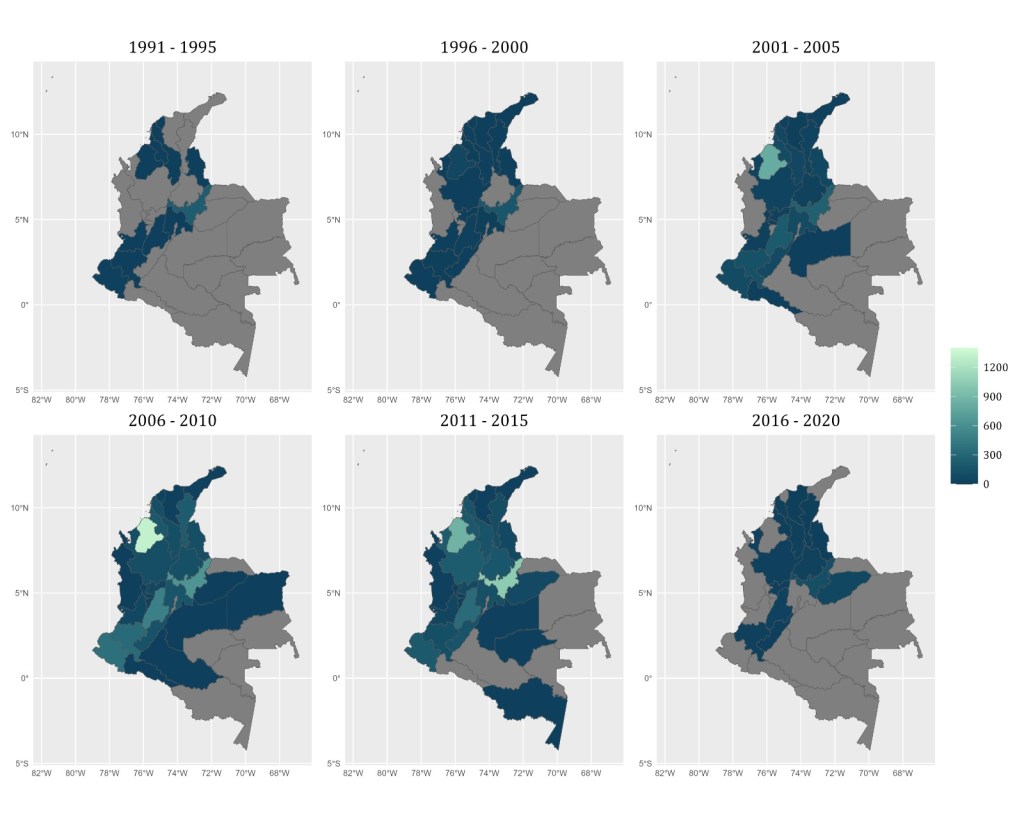
This set of maps displays the number of public land plots handed in by local lower court judges from 1991 to 2018. The darker the department, the higher the number of public land plots. Two clear clusters emerge from this map: one located in the Caribbean region (the northeastern area), and another placed in the Andean region (central area). These maps also show that the phenomenon under study was initially clustered in focal points in early 1990s and began expanding nationwide in the late 1990s and early 2000s. Since 2003, local lower courts significantly allotted public land in Córdoba compared to other departments. Then, Boyacá emerged as another niche for the judicial allocation of public land in mid-200s. After 2016, this phenomenon has shrunk in spatial terms, being limited to Caribbean departments.
Patterns of Allocation at the Village Level in Córdoba
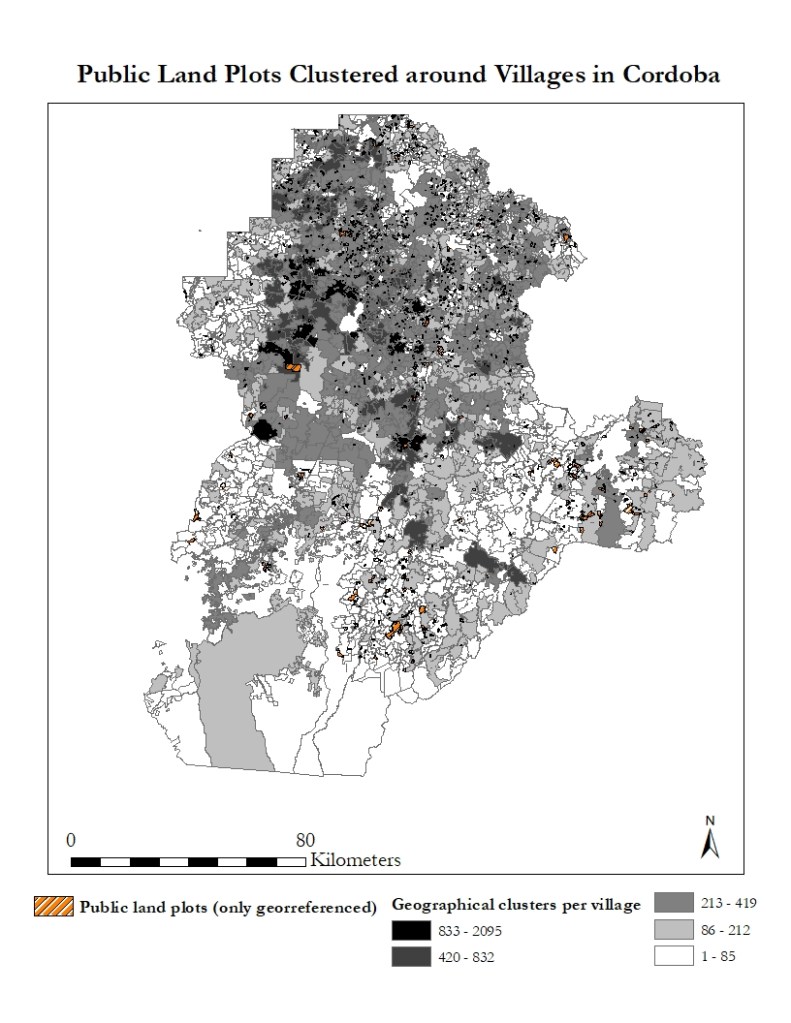
In Córdoba, public land was allotted by local judges in 597 villages (50,4%), yet 22,61% of land plots are in only 6 villages (1%) and 55,6% of registered plots are placed in other 18 villages (3,01%). This geographical variation suggests that the judicial allocation of public land may have had a concentration effect in Córdoba.
Patterns of Allocation at the Village Level in Casanare
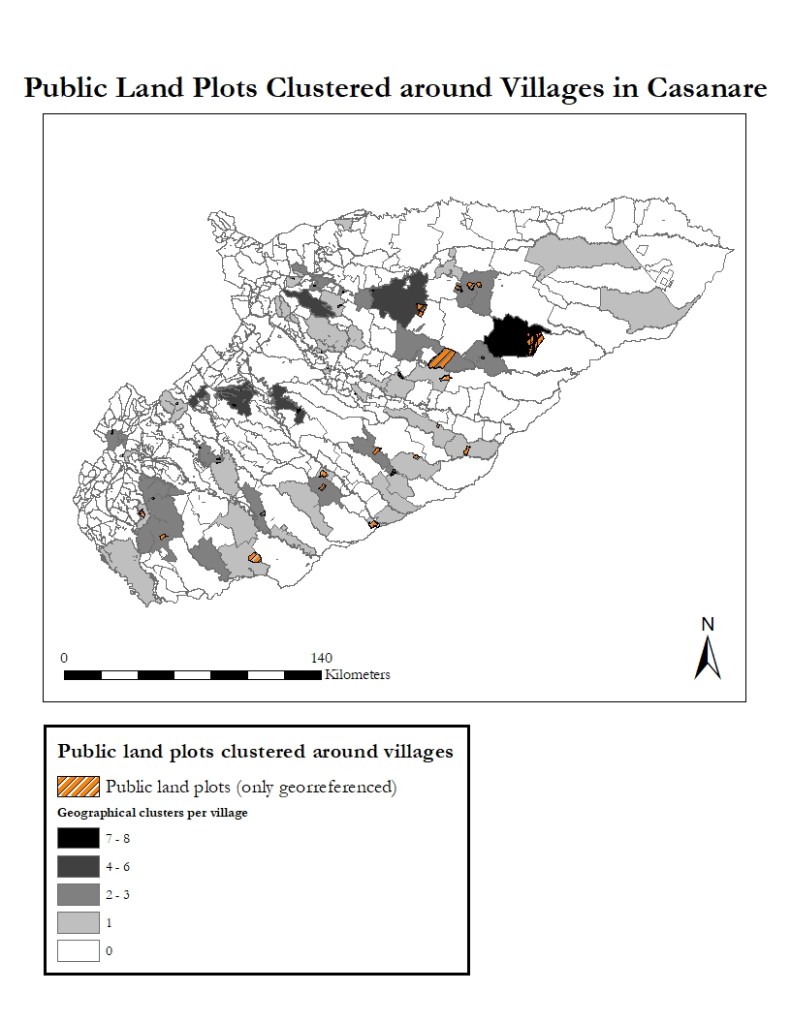
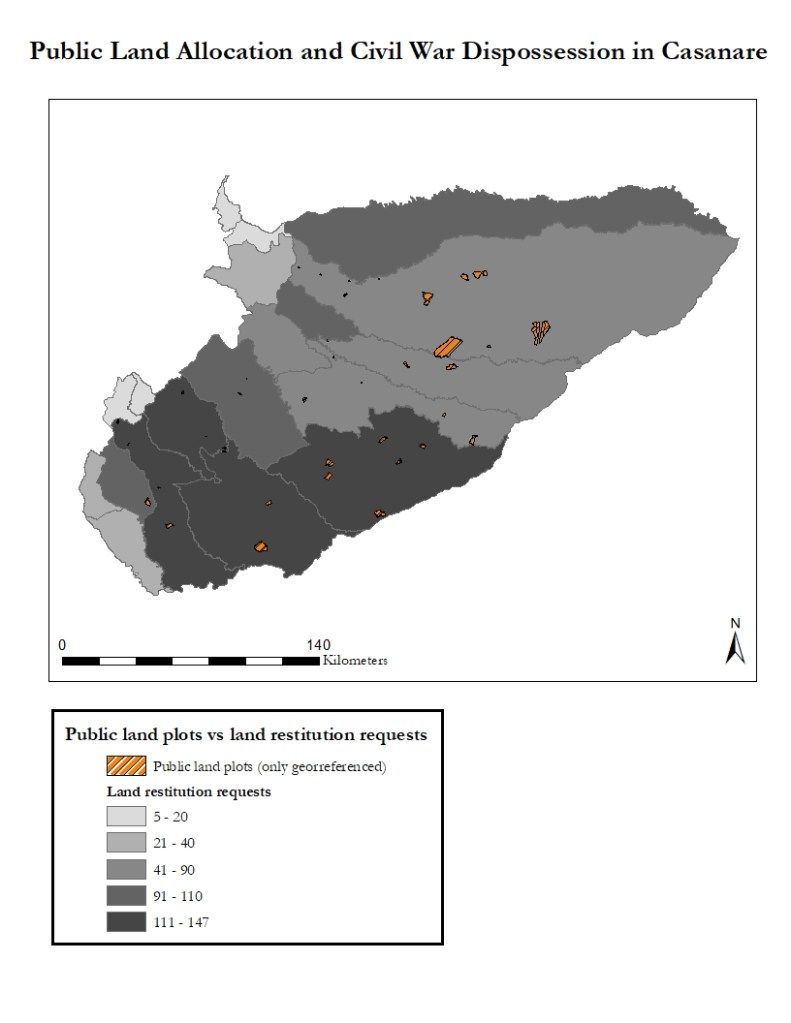
In Casanare, public land allocation is clustered in 41 out of 307 villages (13,35%), suggesting that this mechanism may have triggered a land concentration effect.
Public Land Allocation and Land Restitution Claims in Córdoba
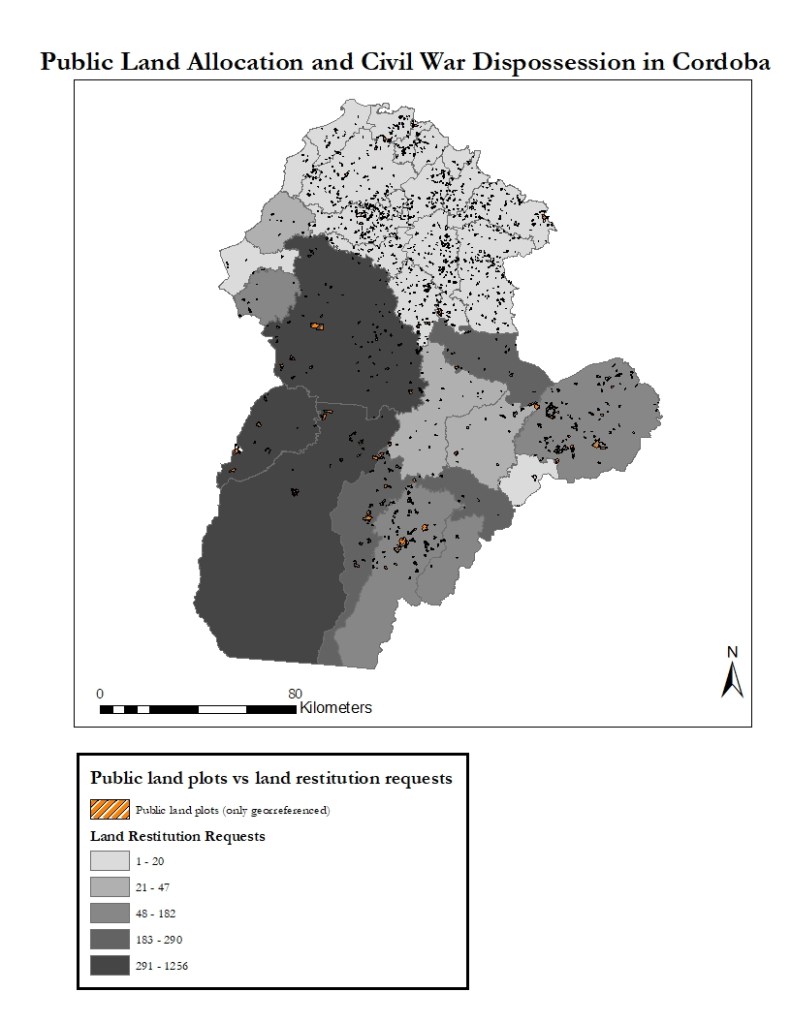
I plotted civil war land dispossession and public land allocation to study any geographical correlation between these two phenomena. Civil war land dispossession is measured by the number of requests filed by petitioners before an administrative body charged with fulfilling victims’ claims for land restitution (e.g., the Land Restitution Unit). This variable is colored in a gray scale and the orange layer represents public land plots. This map does not show a spatial correlation between civil war land dispossession and public land allocation.
Public Land Allocation and Restitution in Casanare.
I also geo-referenced land restitution claims and public land allocation in Casanare. The map below suggests there is not spatial correlation between these two phenomena.
 Isabel Güiza-Gómez